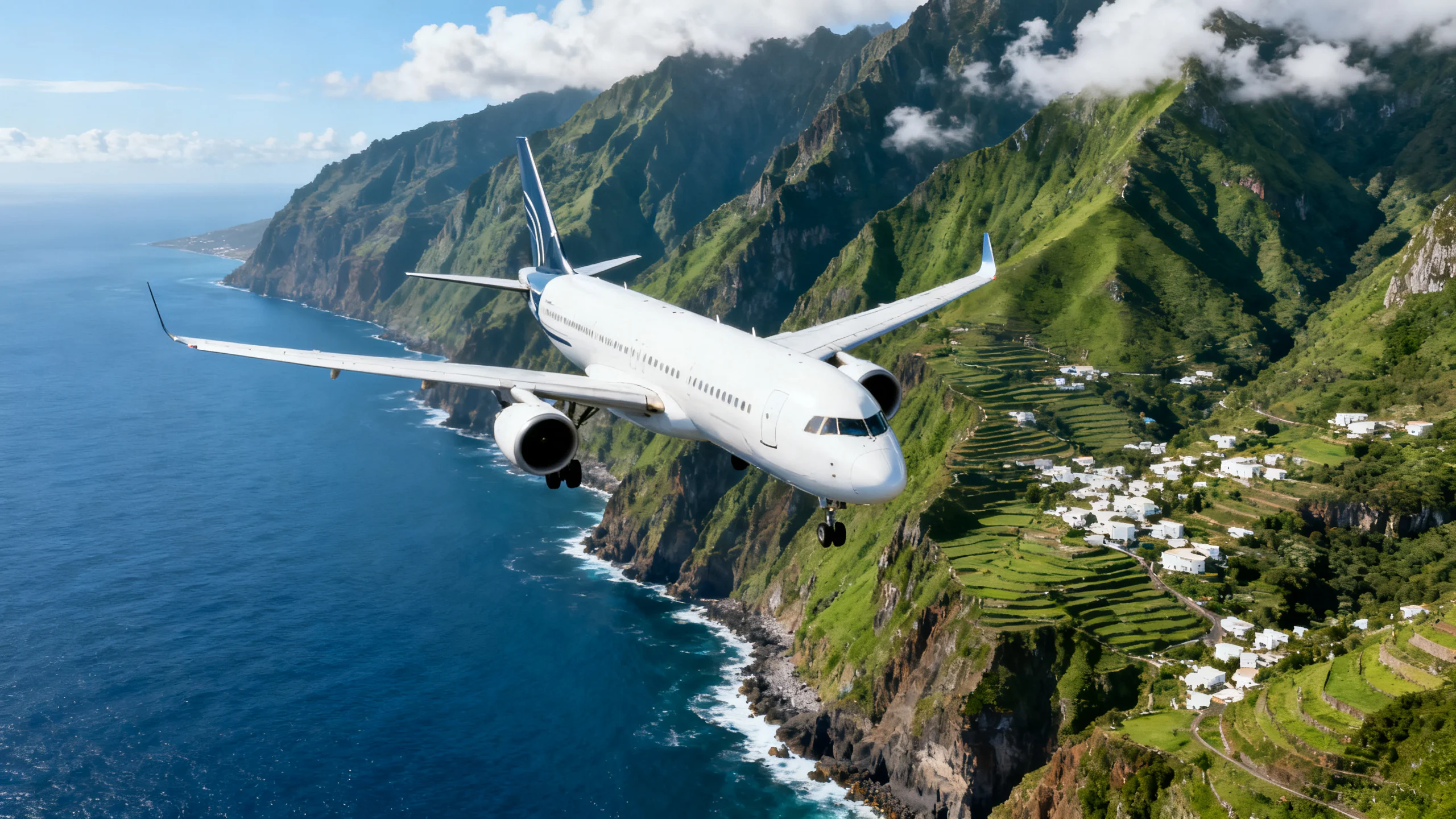
How to reach Madeira: direct flights from Europe, what to expect at the famous clifftop airport, and the ferry link to Porto Santo.
Madeira sits alone in the Atlantic, around 400 kilometres off the coast of Morocco and close to 1,000 from mainland Portugal. For the traveller that means one thing: almost everyone arrives by air. The island is well connected even so, with flights year-round to Lisbon and Porto and a wide spread of direct seasonal routes from across Europe.
This guide covers the airport and its much-discussed runway, the direct flights that exist, how to get from the airport into Funchal, and the two ways across to the sister island of Porto Santo.
The airport and its clifftop runway
Madeira’s airport, formally Cristiano Ronaldo Madeira International Airport and coded FNC, sits at Santa Cruz, about 18 kilometres east of Funchal. It is one of the more talked-about airports in Europe. To take larger jets, the runway was extended out over the sea on a deck of nearly two hundred concrete pillars, an engineering fix to a site hemmed in by mountains and ocean.
The approach is genuinely demanding. Aircraft curve in toward the coast rather than lining up straight, and the wind can funnel hard along the cliffs, so pilots flying here complete specific additional training. On a gusty day you may feel a firm landing or a go-around, and now and then flights divert to Porto Santo or the Canaries to wait for the wind to ease. It is routine for the island, even if it is unsettling the first time.
Direct flights to Madeira
Madeira has no scheduled long-haul routes. Travellers from North America, Asia or the southern hemisphere connect through Lisbon, which has frequent onward flights to the island.
| From | Typical service |
|---|---|
| Lisbon | Several daily, year-round, around 1h35 |
| Porto | Daily, year-round, around 2 hours |
| UK (London, Manchester, more) | Frequent direct, year-round on some routes |
| Germany | Regular direct, heaviest from spring to autumn |
| France, Benelux, the Nordics | Mostly seasonal direct, often weekly |
| Beyond Europe | Connect through Lisbon |
Direct services from continental Europe and the UK are busiest between spring and autumn, and several routes run only in the summer season. Schedules shift from year to year, so check current routes for your dates rather than assuming last year’s map still holds.
From the airport to Funchal
The airport is about twenty minutes from Funchal on the VR1 expressway, and you have several ways to cover it.
- The aerobus, a scheduled airport bus, runs into the city for a few euros.
- Pre-booked transfers and taxis both serve the centre, with taxi fares to Funchal that are predictable rather than metered surprises.
- Hire cars are collected at the airport.
If you are basing in Funchal and only want a car for day trips, it is worth transferring into the city and collecting the car later, rather than paying for it to sit in a hotel garage. Funchal itself is walkable.
Reaching Porto Santo
The sister island of Porto Santo, with its long sand beach, is reached from Madeira in one of two ways.
By ferry. The Porto Santo Line vessel sails from Funchal in a little over two hours, with a near-daily service for most of the year, and it carries vehicles. An annual maintenance period takes the ship out of service for a stretch, so check the schedule if you are travelling in the off-season. The open Atlantic between the islands can be rough.
By air. A short inter-island flight covers the same hop in roughly fifteen minutes, landing at Porto Santo’s own airport. It is the obvious choice if you are short on time or unsure of your sea legs.
A ferry day return is possible and leaves around seven hours on the island, which is enough for the beach but tight for much more.
When booking matters
Fares to Madeira move with the season. The summer peak, roughly July and August, and the New Year period around the famous Funchal fireworks are the most expensive times, and the ones to book months ahead. The shoulder months of April to June and September to October are cheaper and arguably the nicest time to visit. Winter is cheapest of all, with the island still mild.
Frequently asked questions
Is landing at Madeira airport dangerous?
It is a demanding airport, not a dangerous one. The curving approach and the coastal wind are why pilots need extra training to fly here, and the system works: go-arounds and the occasional diversion are the safety margin doing its job. Expect a possibly bumpy final approach and a firm landing on a windy day, and treat it as part of the island’s character.
How long is the flight to Madeira?
From Lisbon it is around an hour and thirty-five minutes, and from Porto about two hours. Direct flights from the UK run roughly three and a half to four hours, and from central Europe around four. There are no direct long-haul flights, so from further afield you add a Lisbon connection.
Do I need to rent a car at the airport?
Not necessarily. Funchal is walkable and well served by buses, so many visitors transfer into the city by aerobus or taxi and hire a car only for the days they take day trips. If you are staying outside Funchal, or want the car from the start, collecting it at the airport is straightforward.
Should I take the ferry or fly to Porto Santo?
The ferry takes a little over two hours, carries cars and gives you the sea crossing, but it can be rough. The flight is about fifteen minutes and much smoother. Choose the flight if you are short on time or prone to seasickness, and the ferry if you want to bring a car or enjoy the passage.
Can I fly to Madeira direct from outside Europe?
Not on scheduled routes. Madeira’s direct network is European, so travellers from North America, Asia or elsewhere connect through Lisbon, which has frequent onward flights to the island. Lisbon is the natural gateway, and a night there can make a long journey easier.