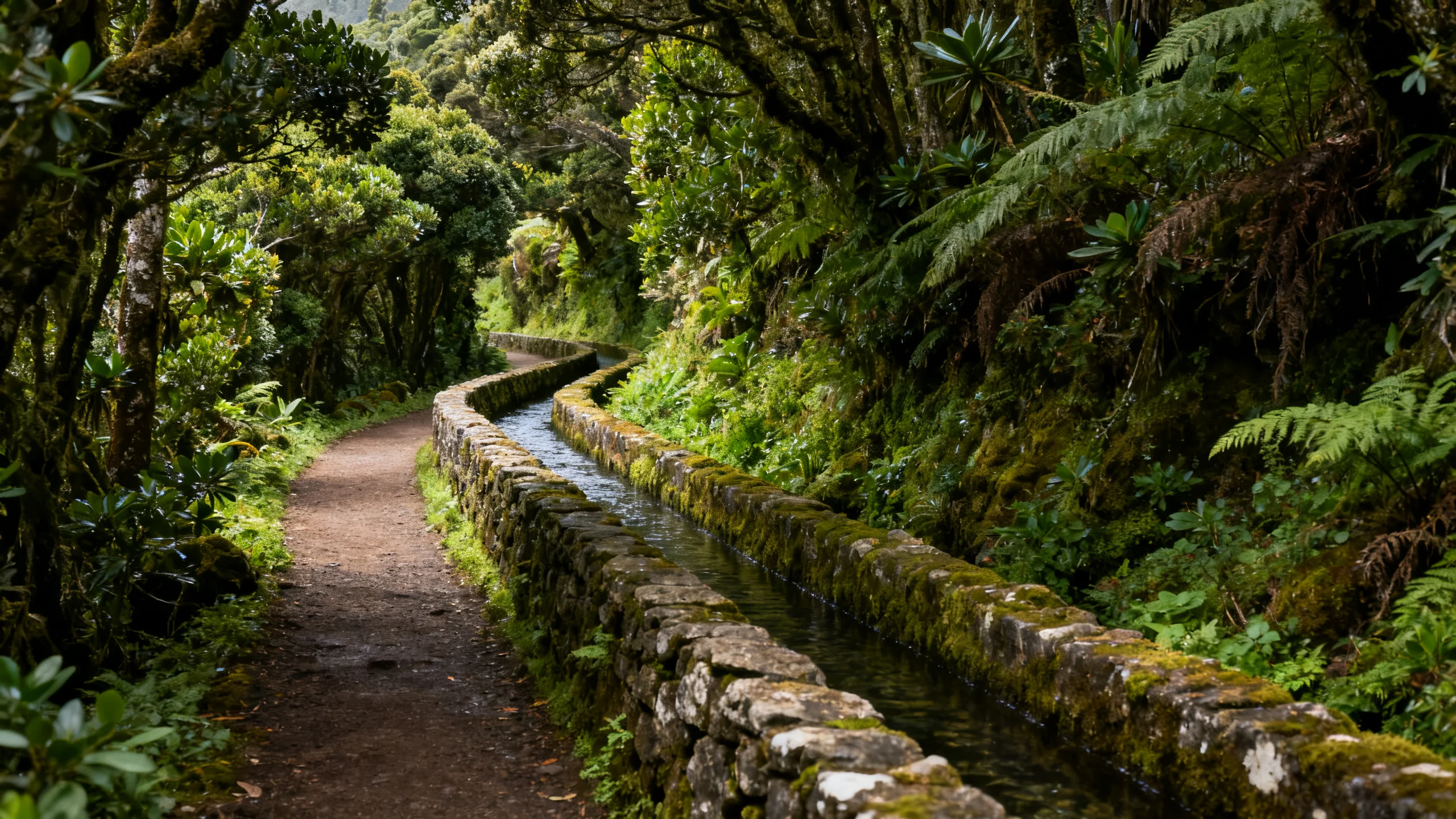
How to walk Madeira levadas safely: what the channels are, easy versus vertiginous routes, head-torches for tunnels, rain closures, and the gear that keeps you steady.
The levada walks are the reason many people come to Madeira, and they deserve their reputation. They are also the activity most likely to get a careless visitor into trouble. A levada path can be a flat, gentle stroll beside running water, or it can be a narrow ledge with an unfenced drop of a hundred metres, and the two do not always look different from the trailhead.
Walking them safely is not difficult, but it is not automatic either. This guide covers what levadas actually are, the gap between an easy route and a vertiginous one, why a head-torch matters, how rain closes trails, and the footwear and layers that keep you steady. Read it before you pick a walk.
What a levada is
Levadas are irrigation channels, hand-cut into the island over centuries to carry water from the wet north and the high interior to the drier, farmed south. The network runs to something like 3,000 kilometres, threading along contour lines through forest, across cliffs and through tunnels bored in the rock. A maintenance path runs alongside each channel so workers can keep the water flowing, and those paths are what you walk.
That origin explains the walks’ character. Because they follow the gradient of a water channel, levada paths are often remarkably flat, which is what makes them accessible. But the same logic puts them on cliff faces and through tunnels wherever the water needed to go, which is what makes some of them serious.
Easy routes versus vertiginous ones
Madeira’s levadas cover a wide range, and choosing the right one for your nerve and fitness is the most important decision you make.
The easy end includes broad, gentle paths through forest with little exposure, suitable for most people in normal walking shoes. These are real walks with real scenery, not consolation prizes.
The serious end includes routes with long sections of narrow path beside a sheer, unfenced drop. The well-known Levada do Caldeirão Verde and Levada das 25 Fontes both have exposure and tunnels and demand a steady head. Routes like the high Pico do Arieiro to Pico Ruivo ridge are mountain walks rather than levadas, with their own exposure and altitude.
If you suffer from vertigo, take it seriously. An unfenced drop does not get less frightening because you have committed to the walk, and turning back on a narrow ledge is harder than not starting. Match the route to the most nervous person in the group, not the boldest.
Tunnels and the head-torch
Many levada walks pass through tunnels, some short, some several hundred metres long, and they are unlit. Inside, the floor is uneven and wet, water drips from the roof, and the channel runs along one side. A phone light is not enough.
Carry a proper head-torch, one per person, with fresh batteries, so your hands stay free for balance and for the rock wall. Walk slowly, watch your footing, and expect to get a little wet. A light waterproof and a willingness to duck for low roof sections make the tunnels straightforward rather than alarming.
Rain, rockfall and trail closures
Madeira’s weather is the biggest variable on the levadas. Heavy rain makes paths slippery, raises the risk of rockfall and landslip on the steep ground above the trail, and can turn a gentle channel into a hazard. The authorities close official trails when conditions are dangerous, and those closures are real, not cautious box-ticking.
Always check the official trail status before you set out, and respect a closure even if the sky looks fine where you are, because the problem is often higher up the route. Rockfall can happen in dry weather too, so do not linger under obviously loose slopes. After a wet spell, give the steeper routes a day or two to settle.
Footwear, layers and fog
The right gear turns a levada walk from a worry into a pleasure.
- Footwear. Proper walking shoes or light boots with a good grippy sole. The paths are stony, often wet, and slick where water crosses them. Smooth-soled trainers and sandals are not adequate for anything beyond the gentlest routes.
- Layers. Conditions change with height and with the time of day. Carry a warm layer and a waterproof shell even on a bright morning, because the forest and the high ground are cooler than the coast and a rain band can roll in.
- Fog. Cloud can settle on a route quickly and cut visibility, which is unnerving on an exposed path. If thick fog comes down, slow right down or turn back rather than pressing on blind near a drop.
Carry water, some food, and a charged phone. Tell someone your planned route and return time. None of this is heavy or expensive, and it covers the realistic risks. For the wider island picture, see the health and safety guide.
Frequently asked questions
What exactly is a levada?
A levada is an irrigation channel, hand-cut over centuries to move water from the wet north and high interior to the drier farmed south. Madeira has roughly 3,000 kilometres of them. A maintenance path runs alongside each channel, and those paths are what walkers follow.
Are levada walks safe if I am afraid of heights?
Some are, some are not. Plenty of levadas are flat, broad and well away from any drop, and those are fine for nervous walkers. Others run along narrow ledges with unfenced drops of a hundred metres or more. Check the exposure of a route before you commit, and choose to match the most nervous person in the group.
Do I really need a head-torch?
For any walk with tunnels, yes. Levada tunnels are unlit, sometimes several hundred metres long, with uneven wet floors. A head-torch keeps your hands free for balance, which a phone light does not. Carry one per person with fresh batteries.
What happens to the trails when it rains?
Heavy rain makes paths slippery and raises the risk of rockfall and landslip, and the authorities close official trails when conditions are dangerous. Always check the official trail status before setting out and respect a closure, even if the weather looks fine where you are, because the hazard is often higher up the route.
What should I wear and carry for a levada walk?
Grippy walking shoes or light boots, a warm layer and a waterproof shell even on a bright day, plus water, some food, a charged phone and a head-torch if the route has tunnels. Tell someone your planned route and return time. The kit is light and inexpensive and covers the real risks.