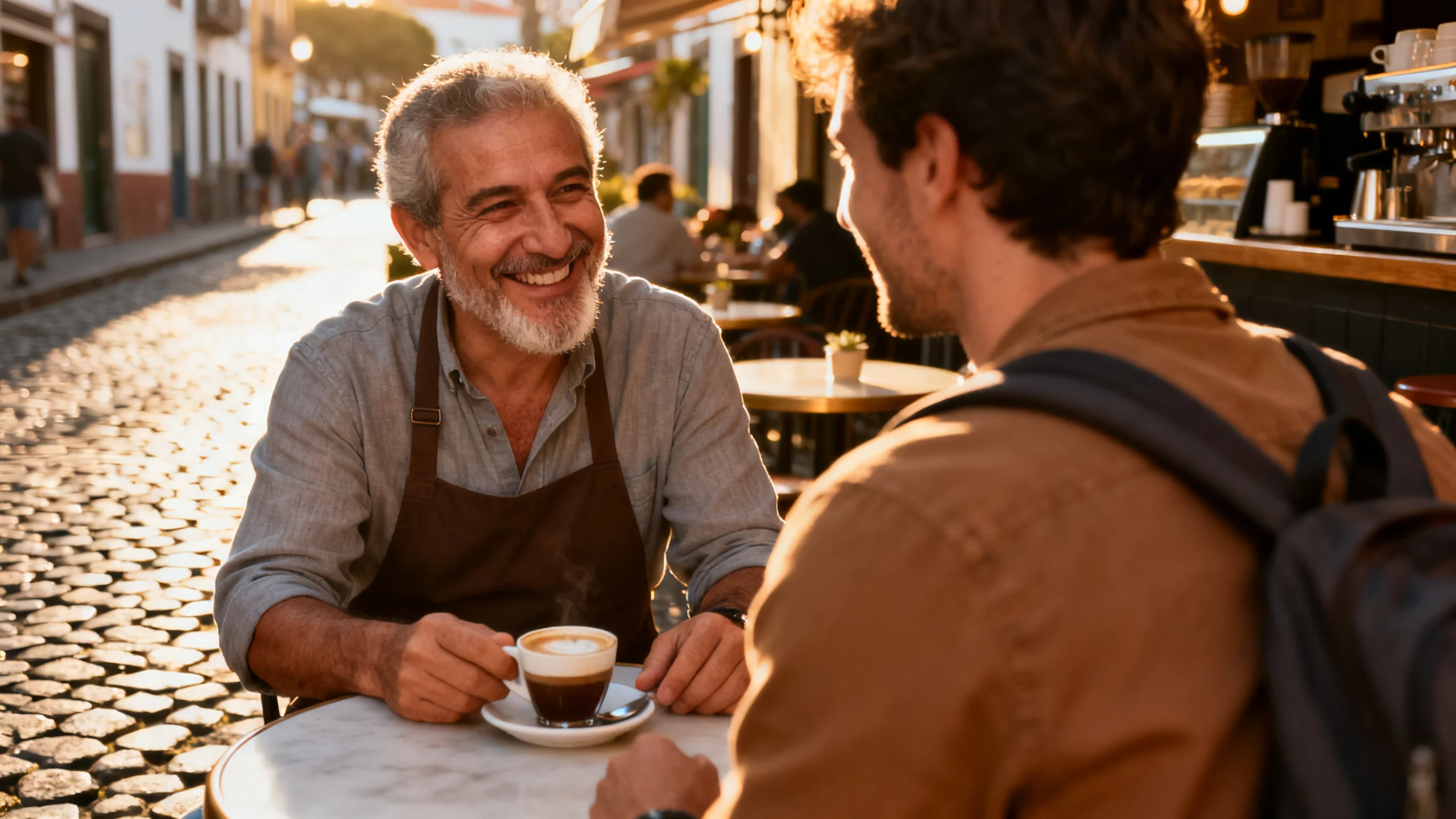
European Portuguese basics for Madeira: greetings, ordering food, asking directions, polite phrases, and a few Madeiran terms that locals appreciate hearing.
You can travel Madeira with no Portuguese at all. English is widely spoken in Funchal’s tourism trade, and in the hotels, restaurants and tour operators you will rarely hit a wall. But the picture changes once you leave the capital. In the rural villages, the inland cafés and among older Madeirans, English thins out, and a handful of Portuguese phrases turns a transaction into a friendly exchange.
This guide covers the 30 or so phrases that genuinely matter, a short pronunciation primer so they land, and a few words specific to Madeira that mark you as a visitor who has paid attention. Learn the greetings and the coffee order at minimum, and the rest is a bonus.
A quick pronunciation primer
European Portuguese, the variety spoken in Madeira, looks a little like Spanish on the page and sounds nothing like it. Three patterns help.
- Final vowels are soft. “Obrigado” lands closer to “ob-ree-GAH-doo” than a hard final “oh”. The last vowel almost fades out.
- The “ão” ending is nasal. Words like “não” (no) and “pão” (bread) are said through the nose, roughly “now” with a hum on the end.
- “Ch” is a soft “sh”. “Chá” (tea) is “shah”.
Do not worry about getting it perfect. The effort itself is what locals respond to.
Greetings and politeness
| Portuguese | Meaning | Notes |
|---|---|---|
| Bom dia | Good morning | Until midday |
| Boa tarde | Good afternoon | Midday until dusk |
| Boa noite | Good evening / good night | Also a goodbye after dark |
| Olá | Hello | Casual, any time |
| Adeus | Goodbye | Fairly formal |
| Até logo | See you later | Casual |
| Obrigado / Obrigada | Thank you (male / female) | Match your own gender, not the listener’s |
| Por favor | Please | |
| Desculpe | Sorry / excuse me | To apologise or get attention |
| Com licença | Excuse me | To pass someone |
Yes, no and the basics
| Portuguese | Meaning |
|---|---|
| Sim | Yes |
| Não | No |
| Não sei | I do not know |
| Não percebo | I do not understand |
| Fala inglês? | Do you speak English? |
| Pode ajudar-me? | Can you help me? |
| Quanto custa? | How much does it cost? |
| Mais devagar, por favor | Slower, please |
Ordering food and drink
| Portuguese | Meaning |
|---|---|
| Uma mesa para dois | A table for two |
| A ementa, por favor | The menu, please |
| Queria… | I would like… (then name or point) |
| O prato do dia | The dish of the day |
| A conta, por favor | The bill, please |
| Está delicioso | It is delicious |
| Tenho alergia a… | I am allergic to… |
Ordering coffee deserves its own note, as you will do it daily. “Um café” gets you a small black espresso, the Portuguese default. “Uma meia de leite” is a coffee with milk. “Um garoto” is a small coffee with a little milk.
Directions and getting around
| Portuguese | Meaning |
|---|---|
| Onde fica…? | Where is…? |
| À esquerda / à direita | Left / right |
| Em frente | Straight ahead |
| Perto / longe | Near / far |
| Um bilhete, por favor | One ticket, please |
| A que horas? | At what time? |
| Onde fica a casa de banho? | Where is the toilet? |
A few Madeiran terms
Madeira has its own words and dishes, and recognising a handful signals a careful visitor.
- Levada (le-VAH-da). The irrigation channels, and the walking paths beside them. Knowing the word is the start of understanding the island.
- Poncha (PON-sha). The local sugarcane, honey and citrus drink.
- Bolo do caco (BOH-loo doo KAH-koo). The round stone-baked flatbread, usually served with garlic butter.
- Espetada (esh-pe-TAH-da). The wood-grilled beef skewer, the island’s signature dish.
- Lapas (LAH-pash). Limpets, grilled with garlic butter, a common starter.
- Quinta (KEEN-ta). A grand hillside estate house, many now hotels.
Numbers and time words
| Portuguese | Meaning |
|---|---|
| Um, dois, três | 1, 2, 3 |
| Quatro, cinco, seis | 4, 5, 6 |
| Sete, oito, nove, dez | 7, 8, 9, 10 |
| Hoje | Today |
| Amanhã | Tomorrow |
| Ontem | Yesterday |
Frequently asked questions
Is English widely spoken in Madeira?
In Funchal’s tourism trade, yes: hotels, restaurants and tour operators all operate comfortably in English. It thins out in the rural villages, the inland cafes and among older Madeirans, which is where a few Portuguese phrases earn their keep.
Should I learn Brazilian or European Portuguese?
European Portuguese, the variety spoken in Madeira. The two are mutually understandable, but the pronunciation differs: European Portuguese is faster, with softer final vowels. A beginner trained on the Brazilian variant will find the local accent noticeably harder to follow.
Is it "obrigado" or "obrigada" for me?
It matches the speaker’s own gender, not the listener’s. Men say “obrigado” and women say “obrigada”, whoever they are thanking. Picking the wrong one is harmless and people understand the intent, but matching your own gender is correct.
Will people switch to English if I struggle?
In Funchal, usually yes, especially with younger people in the tourism trade. In rural areas it is less certain, which is why the basics matter most outside the capital. Opening in Portuguese and then letting the conversation switch is the courteous approach.
Which phrases matter most for a short trip?
The greetings (“bom dia”, “boa tarde”), “por favor” and “obrigado” or “obrigada”, and the coffee and food basics like “um cafe” and “o prato do dia”. Those cover most daily interactions. The directions and numbers are useful extras, and the Madeiran terms are a pleasant bonus.