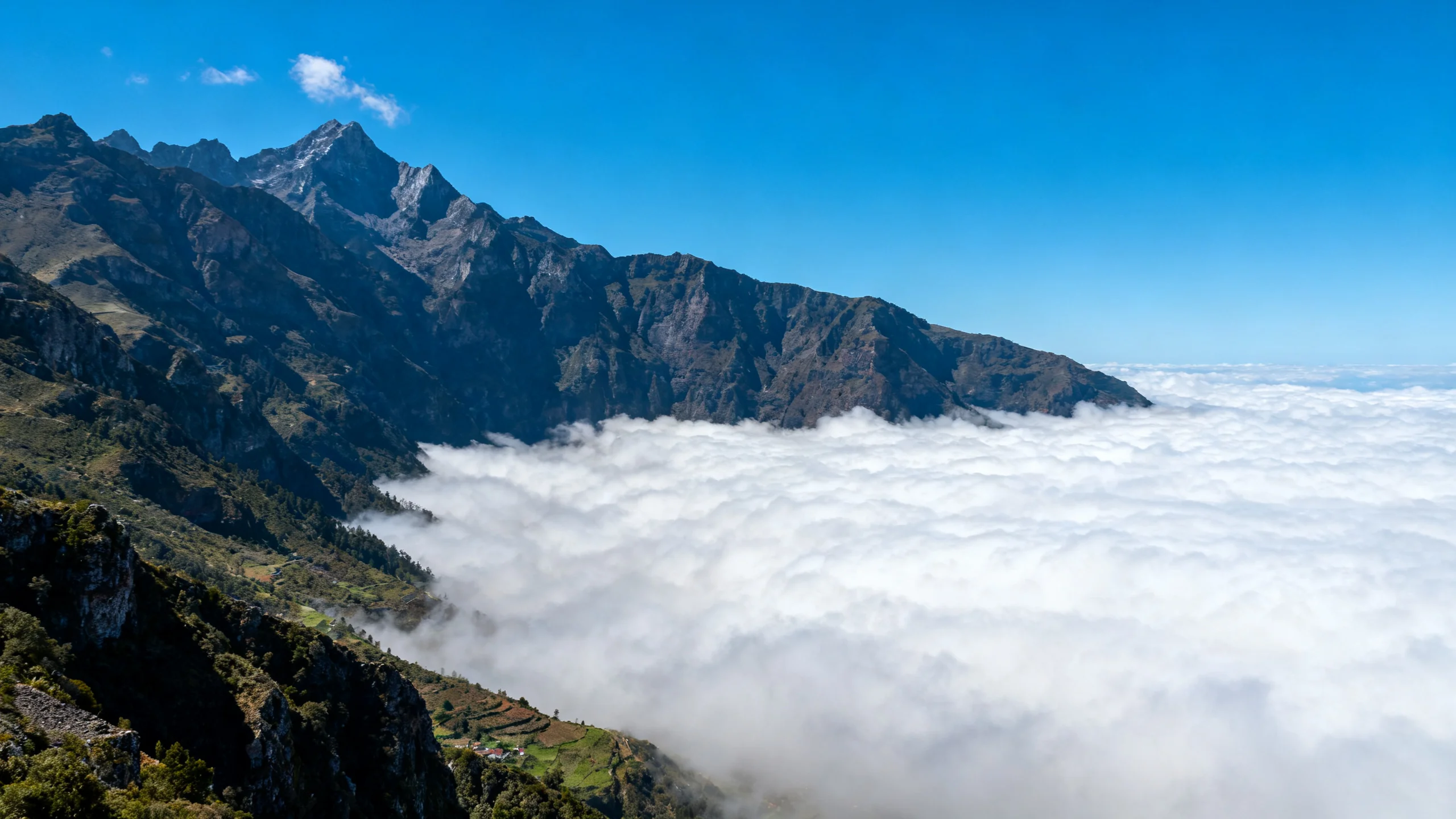
How Madeira weather really works: a dry sunny south, a green cloud-catching north, the inversion layer over the peaks, and why you can drive to find the sun.
The first lesson of Madeira’s weather is that there is no single Madeira weather. The island is a mountain dropped in the Atlantic, and that shape splits it into microclimates that can differ wildly within a short drive. A grey drizzle in one valley sits half an hour from full sun on a south-coast terrace.
Understanding why this happens changes how you plan a day here. Once you know where the cloud forms and where the sun holds, a forecast stops being a verdict and becomes a map. This guide covers the dry south and wet north, the inversion layer that floats over the peaks, the cold of the high ground, sea temperatures, and the single most useful local habit: driving to find the sun.
A dry south and a green north
Madeira’s prevailing winds come from the north and north-east, carrying moist Atlantic air. When that air hits the island’s mountain spine it is forced upward, cools, and drops its moisture as cloud and rain on the northern slopes. By the time the air spills over the ridge and down toward the south coast it has lost much of that moisture, warmed again, and cleared.
The result is a genuine split. The north is wetter, greener and more often cloudy, which is exactly why its laurel forest and its levadas are so lush. The south, including Funchal and the west around Calheta and Ponta do Sol, is drier, sunnier and warmer. The Paul da Serra plateau and the high interior are the wettest of all. None of this is subtle. It is the central fact of the island’s weather.
The cloud line over the central massif
Stand on a high peak on a typical day and you often see something striking: a flat sea of cloud filling the valleys below, with the highest summits poking clear into blue sky above it. This is a temperature inversion, a layer where the air stops cooling with height and instead warms. Cloud forms and gets trapped beneath it, while the peaks above stay clear.
In practice this means the weather at sea level and the weather on the summits are two separate questions. The classic case is sunrise at Pico do Arieiro: the coast can be under cloud while the peak stands in clear dawn light above it. It also means a forecast for Funchal tells you little about whether the central mountains will be in cloud or above it. Webcams at the peaks are more useful than any town forecast for that decision.
The high ground is genuinely cold
It is easy to underestimate the mountains because the coast is so mild. Do not. Madeira’s highest point, Pico Ruivo, reaches above 1,800 metres, and the high ridges are far colder, windier and more exposed than Funchal. Temperatures drop roughly six to seven degrees Celsius for every thousand metres of height, wind adds a serious chill, and frost and the occasional dusting of snow reach the tops in winter.
If you are heading up to walk the ridges or watch a sunrise, dress for a different climate from the one outside your hotel: warm layers, a windproof shell and a hat, even when the coast is in shorts weather. The levada walks safety guide covers what to carry on the higher routes.
Sea temperatures
The Atlantic around Madeira is mild but not tropical. Sea temperatures sit roughly in the high teens Celsius in late winter and climb to the low to mid-twenties by late summer, which is the warmest stretch. It is comfortable for swimming through summer and into autumn, swimmable for many people in spring, and on the cold side in winter. The water stays clear and the south-coast bathing spots are sheltered, which is part of why diving and whale watching run for much of the year.
Drive to find the sun
The single most useful weather habit on Madeira is this: if the sky is grey where you are, drive. Because the microclimates are so sharp and the expressway and tunnels make the island small in time, you can often leave cloud behind in under an hour.
The general rule is that the south and the west hold the sun when the north is under cloud. If a north-coast day looks washed out, the run to Funchal, Câmara de Lobos or the western coast often finds clear sky. The reverse happens less often but does occur. Keep your plans loose, watch which way the cloud is sitting, and treat the forecast as a starting point rather than a fixed schedule.
Frequently asked questions
Why is the weather so different across Madeira?
Madeira is a tall mountain in the ocean. Moist north-easterly winds are forced up its slopes, cool, and drop their rain on the north and the high interior, leaving the south drier and sunnier. That single mechanism creates the sharp microclimates, so the weather can change completely within a short drive.
What is the cloud line you see from the peaks?
It is a temperature inversion. A layer of air a few hundred to a thousand-odd metres up traps cloud beneath it, while the highest peaks rise clear into blue sky above. This is why a sunrise on Pico do Arieiro can be bright even when the coast below is grey.
Do I need warm clothes for the mountains?
Yes. The peaks rise above 1,800 metres and are far colder, windier and more exposed than the coast, with frost and occasional snow in winter. Pack warm layers, a windproof shell and a hat for any mountain walk or sunrise, even when Funchal is warm enough for shorts.
How warm is the sea around Madeira?
Mild rather than tropical. Sea temperatures run roughly in the high teens Celsius in late winter and reach the low to mid-twenties by late summer, the warmest stretch. It is comfortable for swimming through summer and autumn, and on the cool side in winter.
What should I do if the forecast looks bad?
Drive. A single forecast rarely applies to the whole island, so if the north is grey, the south and west often hold the sun, and the tunnels make the crossing quick. Keep both a south-coast and a north-coast plan ready and pick in the morning based on where the cloud is sitting.