Surfing Madeira's west and north coasts: the reef breaks at Jardim do Mar, Paul do Mar and Porto da Cruz, lessons for beginners, and an honest read on the swell.
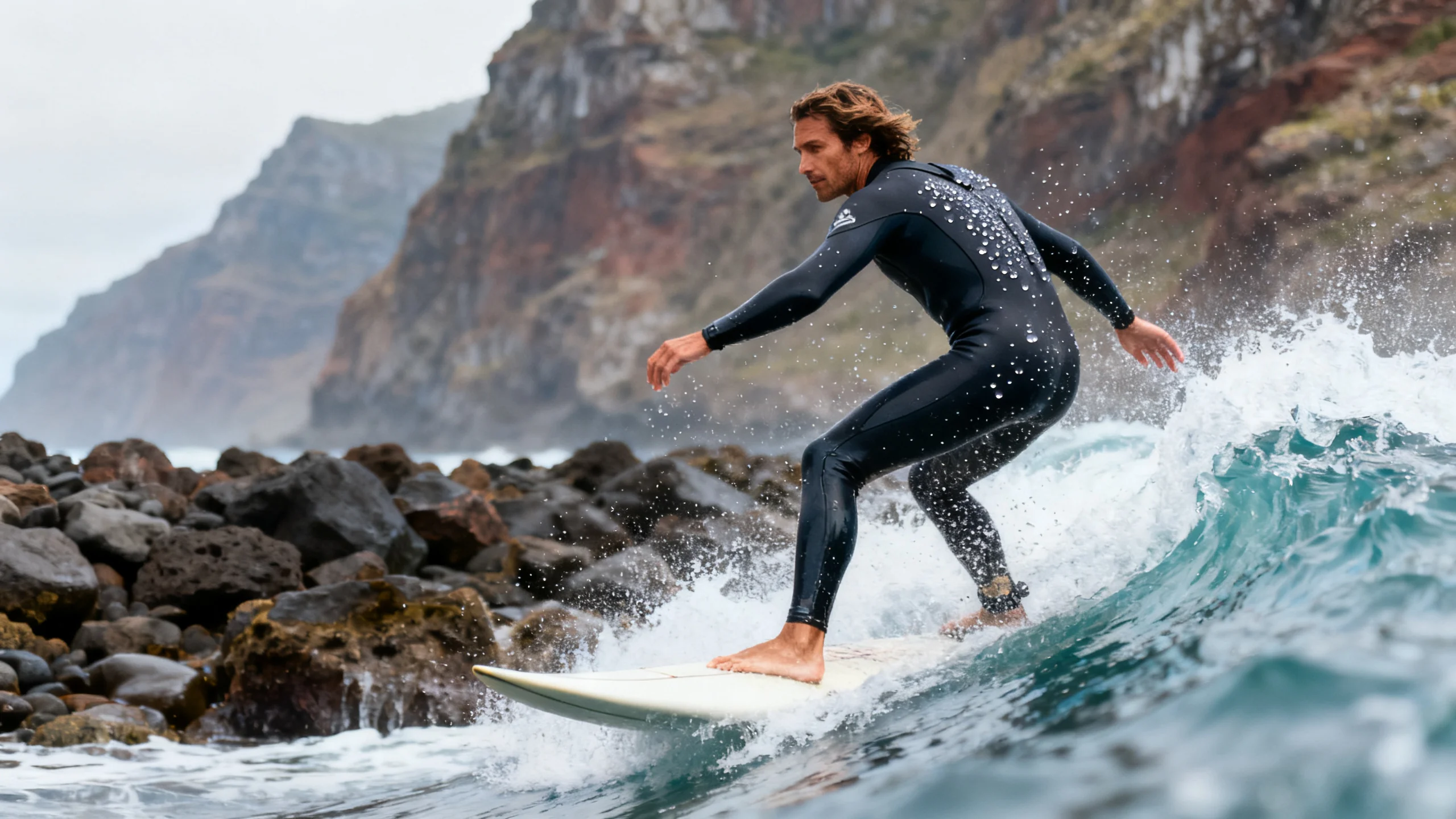
Madeira has a real surf scene, but it is not a beginner’s island. The coast is mostly cliff and boulder, the famous waves break over rock and reef rather than sand, and the best of them are advanced waves with a serious reputation. If you arrive picturing easy beach breaks, you will be looking in the wrong place.
That said, there is good surfing here for the right people, and there are operators running lessons for beginners in safer spots. This guide gives an honest read of the conditions, names the main breaks on the west and north coasts, and explains how a first-timer can get in the water without ending up on a reef they should not be near.
Surfing here, in brief
| Item | Detail |
|---|---|
| Best season | Autumn and winter, when the Atlantic swells arrive |
| Coasts | West coast and north coast; the south is mostly flat |
| Bottom | Reef and boulder, not sand, at the well-known breaks |
| Beginners | Possible with a school, in chosen spots, with care |
| Honest take | A genuine surf island, but skewed toward experienced surfers |
An honest read on the conditions
The headline waves at Jardim do Mar and Paul do Mar are powerful right-hand reef breaks that work on bigger swells and draw experienced surfers from abroad. They are not waves to learn on, and on a big day they are not waves to take lightly at all. The bottom is rock, the takeoff is committing, and local knowledge matters.
The south coast, where most visitors stay, is largely sheltered and usually flat, so it is not a surf coast. The waves are on the west and north sides, and they need an Atlantic swell, which mostly means autumn and winter. In summer the island can go quiet for surf altogether.
None of this rules out a good trip. It just means matching your level to the spot honestly, and using a school if you are not already an independent surfer.
The main breaks
Jardim do Mar, on the west coast, is the most famous wave on the island: a long, powerful right that breaks over rock and has hosted big-wave events. It is strictly for experienced surfers.
Paul do Mar, just along the coast, is another serious right-hand reef break with real power, again squarely in advanced territory.
Porto da Cruz, on the north coast, is the most useful spot for most visitors. It has a more workable setup, including a small stretch of beach, and it is where surf schools commonly run lessons. It is the realistic answer for beginners and improvers.
There are other reefs and points around the island that locals surf, but for a visitor these three names cover the picture.
Lessons for beginners
If you want to actually learn, book with a surf school rather than improvising. The schools run lessons at spots chosen for the conditions, usually around Porto da Cruz on the north coast, and they handle the board, the wetsuit and the read of the day. A lesson buys you their judgement on where it is safe and where it is not, which on this coast is worth more than on a sandy beginner beach elsewhere.
A typical session runs a couple of hours, including the briefing on the sand and the time in the water. Wetsuits are standard year-round, since the Atlantic here is not warm even in summer.
When to go and what to expect
The surf season is autumn and winter, broadly October to March, when the Atlantic sends swell to the west and north coasts. That is also the cooler, wetter half of the year on Madeira, so this is not the same trip as a summer levada-walking holiday.
Summer can be flat, especially for anything beyond the gentlest lessons. If surfing is the main reason you are coming, plan a winter trip and accept that the weather will be mixed. If it is one activity among many, a school lesson on a workable day is the sensible approach.
Frequently asked questions
Can beginners surf in Madeira?
Yes, but only with a surf school and in chosen spots, usually around Porto da Cruz on the north coast. Madeira is not a sandy beginner island, and the famous breaks are advanced reef waves. A school picks a safe spot for your level and supplies the kit. Do not try to learn alone here.
When is the surf season?
Autumn and winter, roughly October to March, when Atlantic swells reach the west and north coasts. Summer is often flat for anything beyond gentle lessons. If surfing is your main goal, plan a winter trip and expect mixed weather.
Are the famous breaks at Jardim do Mar dangerous?
They are serious advanced waves. Jardim do Mar and Paul do Mar are powerful right-hand reef breaks over rock, with awkward entry and exit. On a big swell they are no place for anyone without solid reef experience. Less experienced surfers should watch from the shore and surf elsewhere with a school.
Do I need a wetsuit?
Yes. The Atlantic around Madeira stays cool even in summer, and the surf season is autumn and winter, so a wetsuit is standard. Schools provide one with the lesson; independent surfers should bring or rent a suitable suit.