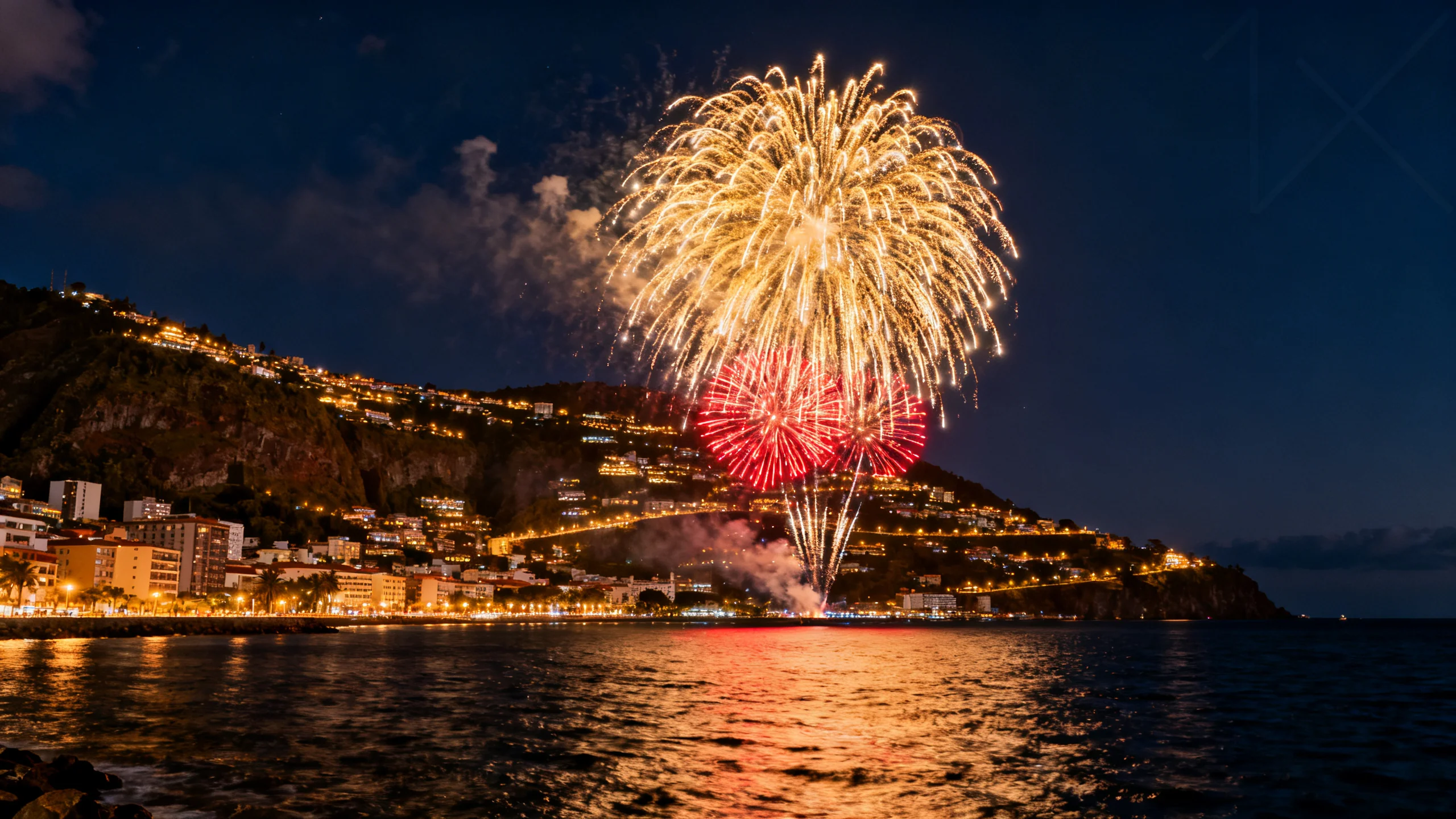
Madeira's festival year: the famous New Year fireworks over Funchal bay, Carnival, the Atlantic Festival, village religious arraiais, and the Wine Festival.
Madeira keeps a busy calendar. The island marks its year with a run of festivals that range from a famous, internationally televised fireworks display to small village saints’ feasts that almost no visitor hears about. Some are spectacles built partly for tourism; others are religious and communal events that would happen whether anyone watched or not.
Knowing the rhythm of this calendar helps you plan a trip, and it also tells you something true about the island: Madeira is sociable, devout in an easy everyday way, and very fond of an outdoor party.
This guide covers the main fixed points of the Madeiran festival year, what each one actually involves, and how they shape the seasons in Funchal and the villages.
New Year: the fireworks over Funchal bay
The single most famous event in the Madeiran calendar is the New Year’s Eve fireworks display over the bay of Funchal.
The geography is what makes it work. Funchal climbs the hillside in a wide amphitheatre around its harbour, so on the last night of the year fireworks are launched from points all around and above the bay at once, and the whole bowl of the city becomes the show. The display was once recognised by Guinness World Records as the largest fireworks show in the world, and although that specific record has since passed elsewhere, the event remains a major draw. Cruise ships anchor offshore for it, hotels fill, and prices for those few days rise sharply. It is genuinely worth seeing once.
Carnival
In February, in the weeks before Lent, Madeira celebrates Carnival, and Funchal in particular puts on a substantial show.
There are two sides to it. The main Carnival parade is a large, organised event with costumed samba-style groups, music and floats moving through the centre of Funchal, in the Brazilian-influenced tradition shared across the Portuguese world. The second is the Cortejo Trapalhão, the “slapstick parade”, a much more anarchic, satirical, anyone-can-join procession where locals dress up to mock the events and figures of the year. The second is often the more enjoyable to watch.
The Atlantic Festival
In June, Funchal hosts the Festival do Atlântico, the Atlantic Festival, and its centrepiece is fireworks again, but in a different form.
The festival runs an international fireworks competition across several Saturday nights in June. Pyrotechnic teams from different countries each stage a display over the bay, choreographed to music, and the events are judged. It is, in effect, the New Year show broken into parts and turned into a contest, set against warm early-summer evenings. The festival also includes a programme of classical music concerts in the city.
Religious arraiais
Beyond the big set-piece events, the most characteristic Madeiran festivals are the arraiais: the village religious feasts, held through the summer and into early autumn in honour of a local patron saint.
An arraial pairs a religious core with a popular one. There is a Mass and a procession, the saint’s image carried through the village, and around it a street party: food stalls grilling espetada and bolo do caco, wine and poncha, folk music, decorations strung between the houses, and dancing into the night. These are the events where you see ordinary Madeiran community life rather than a show staged for visitors. Among the best known is the Festa da Nossa Senhora do Monte in August, the island’s main religious pilgrimage, centred on the church at Monte above Funchal.
The Madeira Wine Festival
At the end of August and into early September, the island marks the grape harvest with the Festa do Vinho, the Madeira Wine Festival.
It has two centres. In Funchal there are exhibitions, tastings, music and re-enactments of the old harvest and wine traditions. In Estreito de Câmara de Lobos, in the heart of the wine-growing slopes, the festival is more rural and hands-on, with grape-treading and harvest scenes. It is a natural pairing with a deeper look at Madeira wine itself, and a good reason to visit at the tail end of summer.
Frequently asked questions
Are the Funchal New Year fireworks worth seeing?
Yes, once. The display fills the whole amphitheatre of the bay because fireworks are launched from all around it at the same time, and it was once a Guinness World Record holder. Be aware that hotels fill and prices rise sharply for the New Year period, so book well ahead.
What is an arraial?
An arraial is a village religious feast held in honour of a local patron saint, common through the Madeiran summer. It combines a Mass and a procession with a street party: grilled food, wine and poncha, folk music and dancing. These are the most authentic festivals on the island.
When is Carnival in Madeira?
Carnival falls in February, in the weeks before Lent, so the exact dates change each year. Funchal holds a large costumed main parade and a more satirical “slapstick” parade, the Cortejo Trapalhão, which many people find the more entertaining of the two.
What is the Atlantic Festival?
The Atlantic Festival is held in Funchal across the Saturdays of June. Its main feature is an international fireworks competition, with teams from different countries staging music-choreographed displays over the bay, alongside a programme of classical concerts in the city.
When is the Madeira Wine Festival?
The Festa do Vinho is held around the end of August and into early September, marking the grape harvest. Funchal hosts tastings, music and re-enactments, while Estreito de Câmara de Lobos in the wine-growing hills runs a more rural celebration with grape-treading.