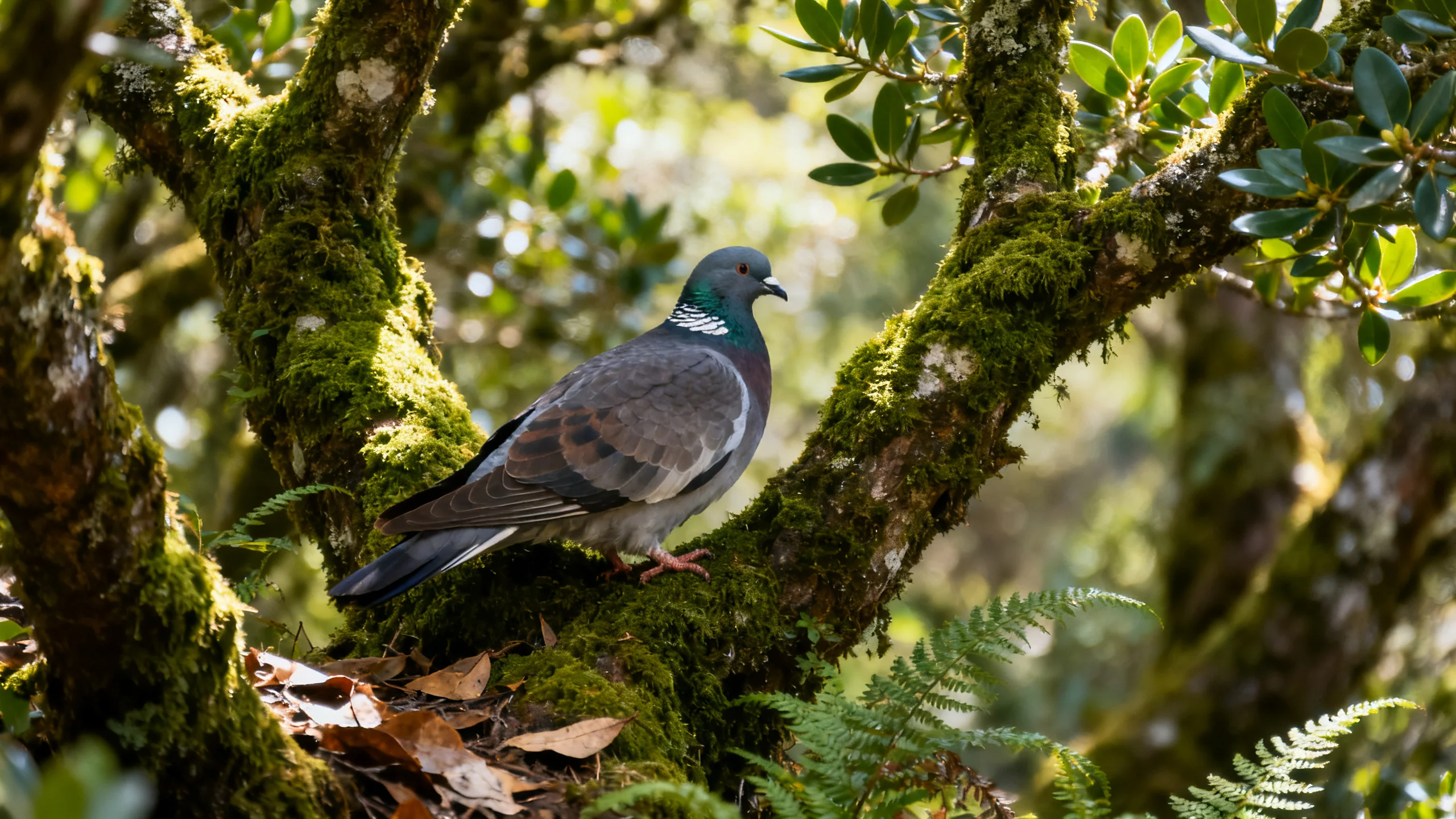
Madeira's unique wildlife: the laurisilva's trocaz pigeon and firecrest, the rare Zino's petrel of the high peaks, and the monk seals of the Desertas.
An island that rose from the ocean, was never connected to a continent, and was empty of people until the 15th century is a natural laboratory. Whatever managed to reach Madeira, by wing, by wind or by chance on driftwood, then evolved in isolation, and a number of species drifted far enough from their mainland relatives to become entirely their own. They are endemic: found on Madeira and nowhere else on Earth.
Some of these animals are easy to see on an ordinary trip. Others are among the rarest creatures in Europe and take real effort, or luck, to glimpse. All of them are part of what makes the island ecologically distinctive, and several are the focus of long-running conservation work.
This guide covers the key endemic and locally special wildlife of Madeira: the birds of the laurel forest, the seabird of the high peaks, and the seals of the Desertas Islands.
Birds of the laurisilva
The laurisilva forest, the ancient laurel woodland of the northern slopes and central highlands, is the heart of Madeira’s endemic life. Two birds in particular belong to it.
The trocaz pigeon (Columba trocaz), also called the Madeira laurel pigeon, is a large pigeon found only on Madeira. It is dark and stocky, with a silvery patch on the neck, and it lives in and around the laurisilva, feeding largely on the fruit of the laurel trees. Heavily hunted and threatened in the past, it has recovered with protection of the forest, and a patient watcher in the laurisilva has a fair chance of seeing one.
The Madeira firecrest (Regulus madeirensis) is at the other extreme of size: one of the smallest birds in Europe, a tiny, restless, gold-and-green bird of the forest canopy. It was once treated as a subspecies of the common firecrest and is now recognised as a full species endemic to Madeira. It is common in the laurisilva but, being tiny and constantly moving, easier to hear than to see.
Zino’s petrel: the rarest seabird in Europe
The most precious bird on Madeira nests not in the forest but high on the bare central peaks, and most visitors never know it is above them.
Zino’s petrel (Pterodroma madeira) is a small seabird that comes to land only at night, and only to breed, on a few high mountain ledges in the central massif around Pico do Arieiro. It spends the rest of its life far out over the Atlantic. For decades it was thought extinct; it was rediscovered breeding in the 1960s. With only a few dozen breeding pairs, it is one of the rarest seabirds in Europe, and possibly the rarest.
It survives because of intensive conservation: predator control on the breeding ledges, monitoring, and the long effort of the Zino family and the local authorities for whom the bird is named. Travellers will not casually see it, but it is worth knowing that the high peaks of the central region hold a creature this rare.
The monk seals of the Desertas
Off the southeast of Madeira lie the Desertas Islands, a chain of uninhabited, arid islets that form a strict nature reserve. Their most important residents are not birds but seals.
The Mediterranean monk seal (Monachus monachus) is one of the most endangered marine mammals in the world. The Desertas hold a small but protected colony, hauling out and breeding in sea caves along the islets’ cliffs. Once hunted nearly to local extinction, the Madeiran population has slowly recovered under reserve protection, and seals are now seen occasionally even off the main island. The Desertas themselves are tightly controlled: access is limited and landing is restricted, which is exactly why the seals are still there.
Other distinctive wildlife
Beyond the headline species, Madeira has a long list of endemic plants, invertebrates, land snails and lizards. The most visible to a casual visitor is the Madeira wall lizard (Teira dugesii), an endemic lizard you will see basking on walls, terraces and rocks all over the island, from the coast to the gardens. The surrounding waters are also rich: the deep sea off the south coast is good for whale and dolphin watching, though those are wide-ranging ocean animals rather than Madeiran endemics.
Frequently asked questions
What animals are unique to Madeira?
The best-known endemics are the trocaz pigeon and the Madeira firecrest, both birds of the laurisilva forest, and Zino’s petrel, a seabird that nests only on the high central peaks. The Madeira wall lizard is an endemic you will see everywhere. Many endemic plants and invertebrates round out the list.
Where can I see the trocaz pigeon?
In the laurisilva forest, the laurel woodland of Madeira’s northern slopes and central highlands. Walking a quiet forest levada early in the day gives a fair chance of a sighting, since the pigeon feeds on laurel fruit. Bring binoculars and move slowly.
How rare is Zino's petrel?
Very rare. With only a few dozen breeding pairs, all nesting on a few high ledges in Madeira’s central massif, it is among the rarest seabirds in Europe. It was once thought extinct and rediscovered in the 1960s. Casual visitors will not see it.
Can I see monk seals in Madeira?
The Mediterranean monk seal survives in a small protected colony on the Desertas Islands, a strict nature reserve with restricted access. Seals are occasionally seen off the main island too, but there is no guaranteed way to see one. The reserve protection is the reason the population has recovered.
Is Madeira good for wildlife watching?
Yes, for a focused trip. The laurisilva offers genuine endemic birds, the wall lizard is everywhere, and the surrounding ocean is excellent for whales and dolphins on a boat trip. The rarest species, Zino’s petrel and the monk seal, are protected and hard to see, but the island still rewards a nature-minded visitor.