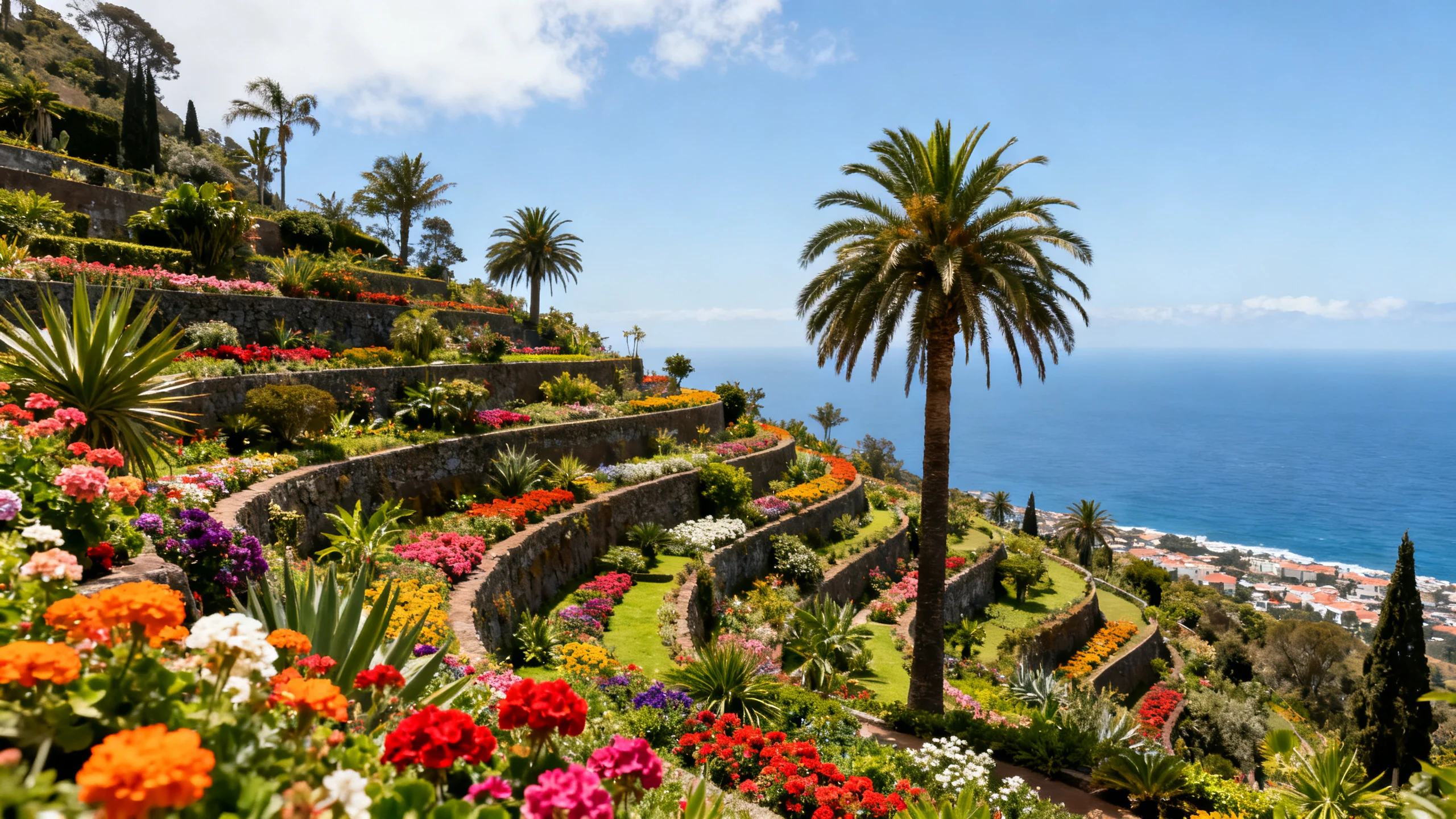
Why Madeira is called the floating garden: its subtropical climate, the great Funchal gardens, and the spring Festa da Flor with its flower carpets.
Madeira is often called the floating garden of the Atlantic, and for once the nickname is earned. The island’s mild, frost-free, year-round growing climate means plants from warm regions all over the world thrive here, often better than in their native ground. Funchal in particular is a city of gardens, public and private, packed onto its steep slopes.
This is not just decoration. Gardening is part of how Madeira sees itself. The grand estate gardens were a project of the merchant families who grew rich on sugar and wine, and the island’s spring flower festival is one of its biggest events of the year. To understand Madeira you have to take the gardens seriously.
This guide covers why the island grows things so well, the major gardens worth visiting, and the Festa da Flor, the spring flower festival held in Funchal.
Why everything grows on Madeira
The floating-garden reputation comes down to climate. Madeira sits in the Atlantic at a subtropical latitude, warmed by the sea, and the south coast around Funchal is mild all year, with no frost and no real cold season. Rainfall is plentiful on the heights, and the island’s range of altitudes means there is a suitable elevation for almost any plant: warm and sheltered low down, cooler and damper higher up.
The result is that gardeners on Madeira can grow an enormous variety of species that would not survive a mainland European winter. Over the centuries plants have been brought in from warm regions across five continents, from South American jacarandas to South African proteas, Asian camellias and Australian trees, and they have settled in and flourished. Funchal in spring, with the jacarandas in violet bloom along its avenues, is the most visible sign of this.
The great gardens of Funchal
Several gardens are worth setting time aside for, most of them on the slopes above the capital.
Monte Palace Tropical Garden
High above Funchal at Monte, reached by the cable car, the Monte Palace garden is the most theatrical of the island’s gardens. It combines dense subtropical planting with water features, koi ponds, and a large collection of imported Portuguese azulejo tile panels set among the greenery. It is a garden to wander slowly, on a network of steep paths, and it pairs naturally with a trip up to Monte.
Jardim Botânico da Madeira
The island’s botanical garden sits on its own hillside east of the centre. It is the more scientific of the two, laid out in formal terraces that group the collections by type: endemic Madeiran plants, succulents and cacti, palms, ornamental species. The geometric beds on the lower slope, planted in bold blocks of colour, are the much-photographed view. The garden gives a clear, organised sense of what the island grows.
Other gardens worth knowing
Funchal has more. The Santa Catarina park above the marina is free, open and good for an hour in the sun. The Quinta do Palheiro Ferreiro, a private estate garden east of the city, is one of the finest, blending English-style design with subtropical planting. Several hotel and quinta gardens are open to non-residents. The whole city rewards a slow eye for what is growing.
The Festa da Flor
Madeira’s gardening culture has its public celebration in the Festa da Flor, the Flower Festival, held in Funchal in spring, usually in the weeks after Easter when the island is at its most colourful.
The festival fills the centre of Funchal with flowers for several days. Its two best-known elements are these:
The Wall of Hope. In a ceremony in the city centre, children each place a single flower into a large wall, building up a vast floral mosaic. It is the symbolic heart of the festival, an expression of a wish for peace.
The flower-carpet procession. The festival’s main parade sees floats and costumed groups move through the centre, and the streets and squares are laid with intricate carpets and designs made entirely from cut flowers and petals. The craftsmanship in these carpets is the festival’s signature image.
Around these are flower markets, exhibitions and displays across the city. The Festa da Flor is one of the high points of the Madeiran year and a reason in itself to visit in spring.
Frequently asked questions
Why is Madeira called the floating garden?
Because its mild, frost-free subtropical climate lets plants from warm regions all over the world grow easily, often better than in their native habitat. The island is intensely green and flowered for much of the year, and Funchal in particular is full of gardens, which earned it the floating-garden nickname.
Which is the best garden to visit in Funchal?
For atmosphere and variety, the Monte Palace Tropical Garden, reached by cable car. For a clear, organised look at what the island grows, the Jardim Botânico. Many visitors do both, since they have quite different characters. The Quinta do Palheiro Ferreiro is also outstanding if you have more time.
When is the Madeira Flower Festival?
The Festa da Flor is held in spring in Funchal, usually in the weeks after Easter, so the exact dates move each year. It runs over several days and centres on the Wall of Hope ceremony and the flower-carpet procession. Check the year’s dates before booking if the festival is your reason for visiting.
What is the Wall of Hope?
It is the symbolic centrepiece of the Flower Festival. In a ceremony in central Funchal, children each add a single flower to a large wall, building up a vast floral mosaic as an expression of a wish for peace.
Are the gardens worth visiting outside spring?
Yes. Madeira’s climate keeps the gardens green and flowering all year, so any season works for a visit. Spring adds the jacaranda bloom and the Flower Festival, but the Monte Palace garden, the Jardim Botânico and the rest are rewarding whenever you come.