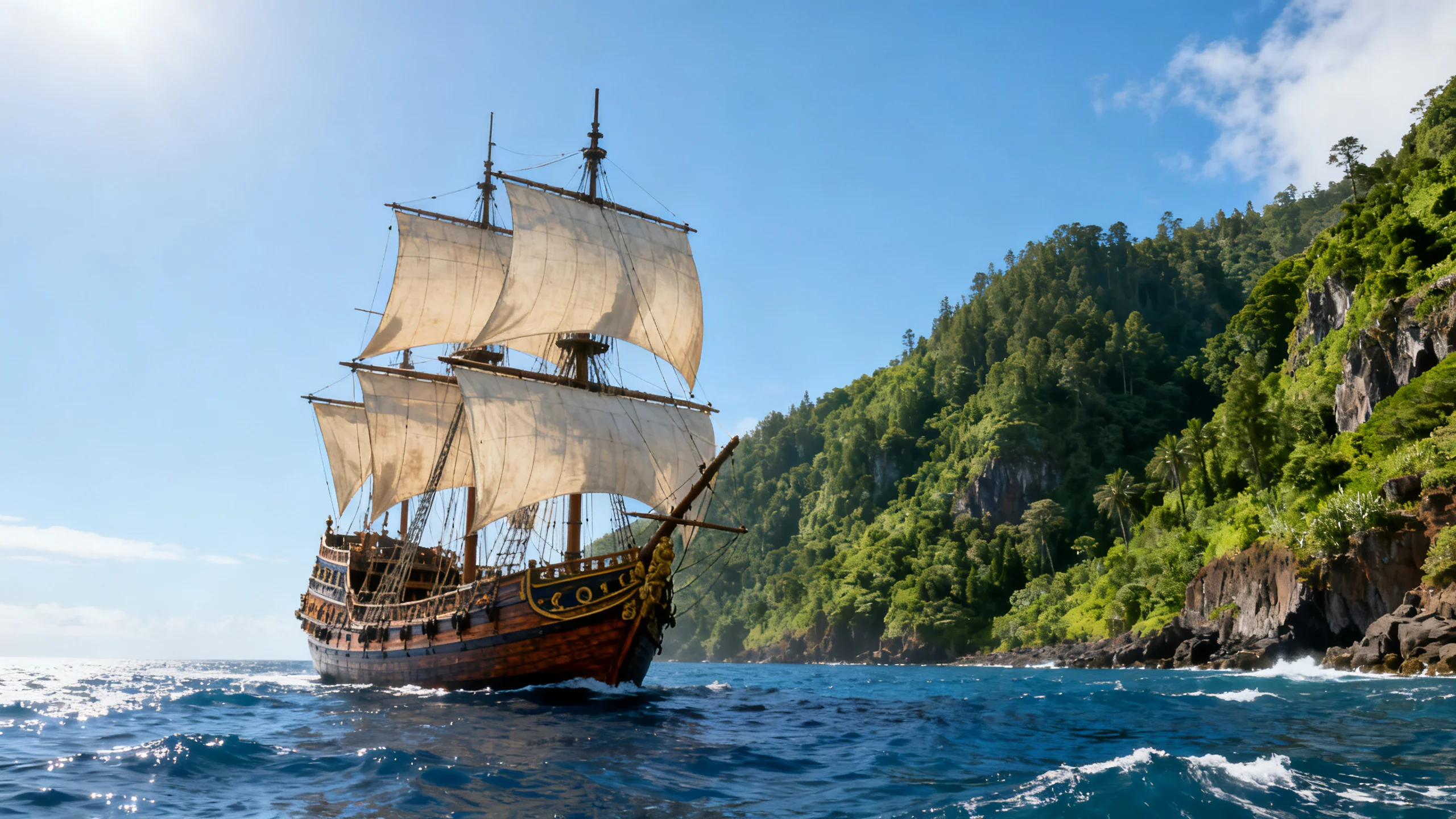
How Madeira went from an empty Atlantic island to a Portuguese colony after 1419: the discoverers, the great clearing fire, the sugar boom, and the captaincies.
Madeira has no native people, no ancient ruins, and no pre-Portuguese history. When the first Portuguese ships reached it around 1419, the island was empty: densely forested, uninhabited, and unclaimed. Everything on Madeira today, every village, every terrace, every levada, was built from that blank start in a little over six centuries.
That is unusual, and it makes Madeira’s story easy to follow. There is a clear beginning, a known set of people who started it, and a single economic engine, sugar, that drove the first century of settlement. The island as it now exists is the direct result of decisions made by a small group of men in the 1420s.
This guide covers what was found in 1419, who the discoverers were, where the name comes from, the fire that cleared the land, and the sugar economy and captaincies that organised the new colony.
An empty island in 1419
Madeira sits in the Atlantic about 700 kilometres off the Moroccan coast and roughly 1,000 kilometres from mainland Portugal. It was probably known to earlier sailors and may appear on medieval charts, but no one had settled it. When Portuguese captains arrived in the early 15th century, in the first decades of Portugal’s age of exploration, they found an island covered almost entirely in forest, with abundant fresh water and a mild climate, and nobody living on it.
The first landfall was Porto Santo, the smaller, drier island to the northeast, reached around 1418. The much larger main island, visible as a dark mass on the horizon, was reached the following year.
The discoverers
Three men are credited with the discovery and the first settlement, all of them in the service of Prince Henry, later known as Henry the Navigator.
João Gonçalves Zarco and Tristão Vaz Teixeira are named as the captains who reached the main island around 1419. Zarco’s name is the one most attached to Madeira; he later governed the Funchal captaincy and is commemorated across the island.
Bartolomeu Perestrelo was given Porto Santo. His captaincy there is a minor footnote with one famous later connection: his daughter married Christopher Columbus, who is believed to have lived on Porto Santo for a time.
These were not explorers passing through. They were sent to take possession of the islands and to make them productive, and they brought settlers, livestock and seed to do it.
Why it is called Madeira
The name is plain and descriptive. Madeira is the Portuguese word for wood, and the island was named for what struck the first arrivals most: it was thickly forested, top to bottom, in dense subtropical woodland. The full early name was Ilha da Madeira, the island of wood.
That forest was both the island’s first resource and its first obstacle. The timber was valuable, but the land underneath it had to be cleared before anything could be farmed.
The great fire
The clearing of Madeira is remembered through one dramatic, and probably partly legendary, episode: a fire, set to burn off the forest and open the land, that ran out of control. The story has the blaze burning for years and forcing the settlers to take refuge at the coast or even offshore until it died down.
The detail is hard to verify and the timescale is almost certainly exaggerated. What is not in doubt is that the lower slopes of Madeira were cleared by fire and axe in the early decades of settlement, and that the original forest was pushed back to the steep, wet, hard-to-reach ground where the laurisilva survives today. The settled, cultivated Madeira and the wild forested Madeira were separated in those first years, and the line has barely moved since.
The sugar economy and the quintas
Cleared land needed a crop, and the crop that made Madeira rich was sugarcane. In the 15th century sugar was a luxury in Europe, scarce and extremely valuable, and Madeira’s mild climate suited it well. The colony was built around it.
Sugar reshaped the island. It paid for the irrigation channels, the levadas, that carried water from the wet north to the dry, sugar-growing south. It funded the merchant class and the church. It also drew in enslaved and forced labour, an uncomfortable but real part of the early plantation economy. And it created the quinta: the country estate, a landholding with a grand house, gardens and farmland, that became the characteristic form of wealth on the island. The quintas of the hills above Funchal trace their origins to this period.
When the sugar trade later faltered, undercut by larger producers in Brazil and the Atlantic islands, Madeira shifted its estates and its energy toward wine, and Madeira wine became the next engine of the economy.
The three captaincies
The new colony was not governed as a single unit. The Portuguese crown divided it into three hereditary captaincies, each granted to one of the founding captains and passed down within his family.
| Captaincy | Where | Granted to |
|---|---|---|
| Funchal | Southern Madeira | João Gonçalves Zarco |
| Machico | Eastern Madeira | Tristão Vaz Teixeira |
| Porto Santo | The sister island | Bartolomeu Perestrelo |
A capitão-donatário, a lord-captain, held wide powers over land, justice and settlement within his captaincy. The system tied each founder’s family to a piece of the island and shaped where towns grew. Funchal, on the sheltered sunny south coast, soon outgrew the others and became the capital it still is.
Frequently asked questions
Was Madeira inhabited before the Portuguese arrived?
No. Madeira had no native population. The island was empty and forested when Portuguese ships reached it around 1419, which is why it has no pre-Portuguese ruins or indigenous culture. Everything on the island has been built since settlement began in the 1420s.
Who discovered Madeira?
The Portuguese captains João Gonçalves Zarco and Tristão Vaz Teixeira are credited with reaching the main island around 1419, in the service of Prince Henry the Navigator. Bartolomeu Perestrelo received Porto Santo, the smaller island reached a year earlier.
What does the name Madeira mean?
Madeira is the Portuguese word for wood. The island was named for its dense forest cover, which was the first thing the arriving settlers saw. The full early name was Ilha da Madeira, the island of wood.
What was the great fire of Madeira?
It refers to the burning of Madeira’s forest to clear land for farming in the early years of settlement. Tradition says a deliberate fire ran out of control and burned for a long time. The timescale is probably exaggerated, but the lower slopes were genuinely cleared by fire, pushing the original forest up to the steep ground where it still survives.
Why was sugar so important to early Madeira?
Sugar was a scarce, high-value luxury in 15th-century Europe, and Madeira’s climate suited sugarcane well. It became the colony’s first economic engine, funding the levadas, the merchant class and the country estates known as quintas, before the island later turned to wine.